Jump to section
Trust & Will is the largest consumer-facing estate planning company. Their consumer "Learn" hub has thirty articles. Their financial-advisor section has three. They just published a B Corp recertification announcement and a 24-minute industry research report titled the 2026 Estate Planning Report. They are also the company most advisors think of when they search "white-label estate planning." The product does not exist.
That gap is not an oversight. Trust & Will sells advisor-channel access to a consumer brand. Real white-label is structurally the opposite. The reason has nothing to do with engineering effort and everything to do with how the company grows. Vendors whose growth model depends on consumer brand exposure inside the advisor's book cannot ship real white-label. For the feature-level comparison behind that claim, see our Bancroft vs Trust & Will breakdown. The surface that powers the flywheel is the surface white-label removes. This piece is the structural test.
How Trust & Will actually positions to advisors
Walk the Trust & Will site as a financial advisor evaluating the platform. The consumer pages dominate: thirty learn-hub articles on wills, trusts, probate, guardianship, end-of-life planning, planned giving. The advisor section, by their own taxonomy, holds three pieces (one short essay on digital estate planning, one parenting-conversation guide, and one published case study, Deane Wealth Management). The attorney section holds another three. The B Corp recertification announcement, the CTO hire, and the 2026 Estate Planning Report appear in the news feed alongside both audiences.
Where the published surface actually points
| Audience | Published pieces | What that signals |
|---|---|---|
| Consumer | Thirty learn-hub articles across wills, trusts, probate, guardianship, end-of-life planning and planned giving. | The audience the content engine was built to acquire. |
| Financial advisor | Three: one short essay on digital estate planning, one parenting-conversation guide, one case study. | A channel, served enough to be credible, not enough to be the business. |
| Attorney | Three. | The same. |
Audience
Consumer
Published pieces
Thirty learn-hub articles across wills, trusts, probate, guardianship, end-of-life planning and planned giving.
What that signals
The audience the content engine was built to acquire.
Audience
Financial advisor
Published pieces
Three: one short essay on digital estate planning, one parenting-conversation guide, one case study.
What that signals
A channel, served enough to be credible, not enough to be the business.
Audience
Attorney
Published pieces
Three.
What that signals
The same.
There is also a separate B2B platform under the same ownership: EstateOS, launched 2025, branded "EstateOS by Trust & Will." EstateOS is the operating-system layer (plan-score, document extraction, connected-network features for advisors, attorneys, nonprofits, and institutions) that powers the dedicated advisor and attorney channels. Trust & Will publicly claims 1 million users, 20,000 financial advisors, 200+ institutional partners, and $200B+ in self-reported assets tracked on EstateOS at launch. The advisor channel is real, the engineering investment is substantial, and the brand on the platform is "EstateOS by Trust & Will" rather than the advisor's firm.
What this two-brand layout tells you: Trust & Will's growth surface is the consumer AND the professional channel under the same parent brand. Advisors and attorneys are distribution channels for the consumer brand, with EstateOS as the B2B operating system. Bringing EstateOS into the picture matters because it rules out the obvious "they just have not built the B2B engineering yet" explanation for the missing white-label tier. They built the B2B engineering. They branded it EstateOS. They kept the parent brand visible. The choice to ship a co-branded "EstateOS by Trust & Will" platform rather than an advisor-brandable one is the structural choice the rest of this piece unpacks.
The pricing follows. Trust & Will's direct-to-consumer pricing is the published anchor (a will package at $199, a trust package at $499 as of the most recent industry checks); the advisor-channel offer is a discount path into the same product rather than a separate product the advisor brands as their own. The growth model is honest. The 2026 Estate Planning Report quotes household scale. The B Corp recertification is real. The consumer brand recognition is the moat the company has spent ten years building, and EstateOS extends rather than replaces it. None of the flywheel works without the brand surface staying visible inside every advisor account the company distributes through. Asking the parent company to ship real white-label is asking it to break the asset that produced the household and advisor scale in the first place.
The consumer-brand flywheel
Every consumer-channel estate-planning vendor runs the same flywheel. Spend on consumer acquisition. Each household completes a plan. Each plan becomes a referral source for the next household. The platform brand accumulates trust impressions across millions of household interactions. Over a decade those impressions compound into the recognition that lets the vendor charge a premium and close consumer customers without spending the prior decade's acquisition cost on each one.
The flywheel runs on brand exposure per household session. Every login screen, every email, every generated document, every footer attribution adds one impression. The mathematics of brand recognition need volume; volume comes from household session count; session count is captured per platform deployment. Take the brand surface away from a household session and the impression count drops to zero for that session.
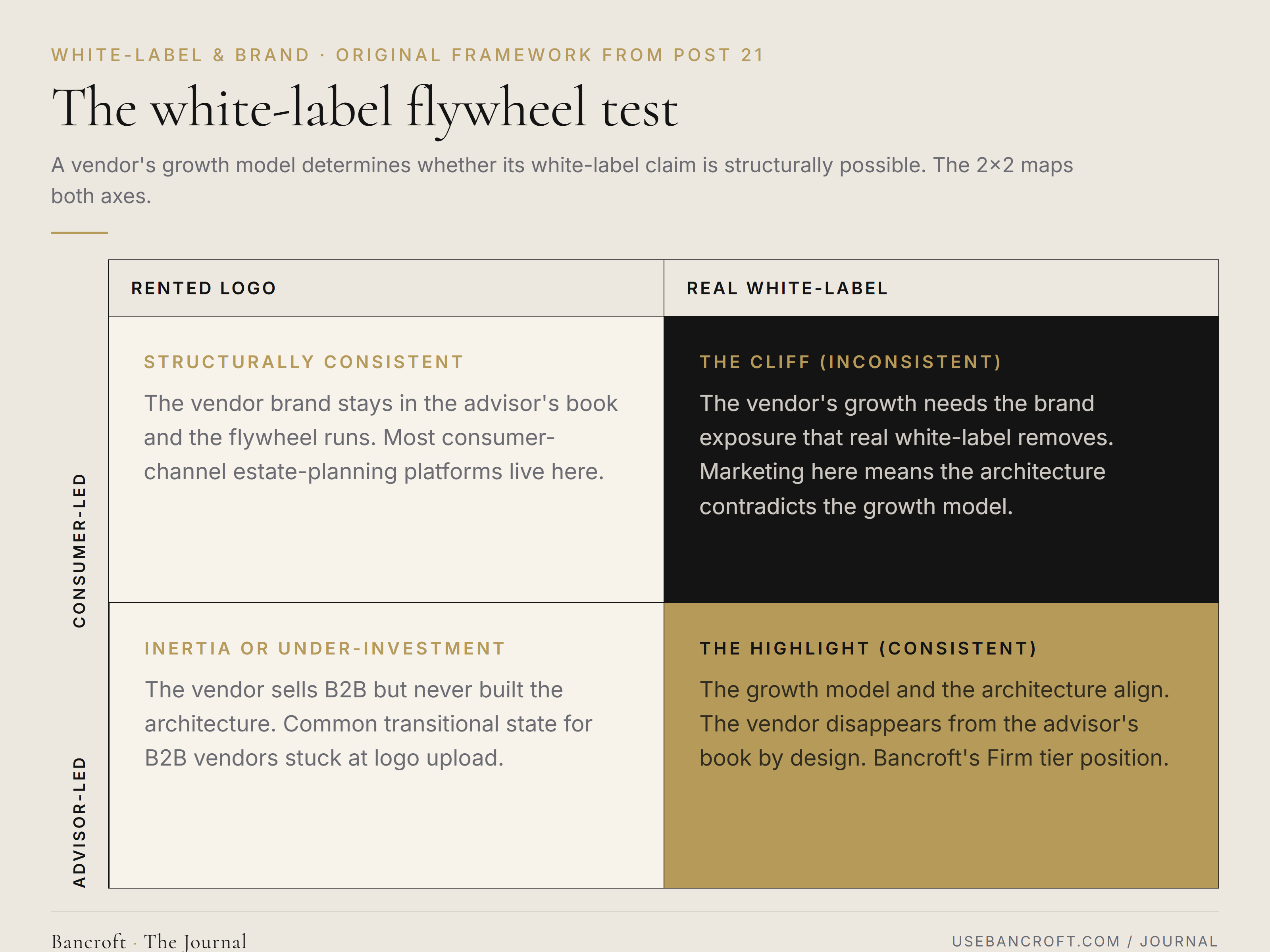
For a vendor in the top half of the quadrant, advisor-channel deployment is a brand-distribution asset. Each advisor account ships incremental impressions to the household. Each impression compounds the flywheel. White-label, in the real sense (custom domain, branded portal, branded transactional email, branded document metadata), removes the impressions. The vendor would be paying for the engineering to neutralize its own growth asset. Almost no consumer-brand company funds that build.
Why the flywheel and real white-label are structurally incompatible
The incompatibility is not theoretical. It shows up at the budget allocation meeting every quarter. Engineering hours that go into multi-tenant DNS automation, per-tenant SSL provisioning, brand resolution at the middleware layer, and per-tenant transactional email infrastructure are hours that do not go into consumer acquisition, conversion funnel optimization, or the product features that drive direct-to-consumer revenue. For a consumer-brand-led company, the second list is the priority list. The first list never makes the quarterly roadmap.
You will see the choice expressed in product surfaces. The "white-label" tier at a consumer-brand-led vendor typically ships logo upload, color customization, maybe a co-branded header. The advisor's portal sits at vendor.com/yourfirm or yourfirm.vendor.com. The password-reset email arrives from no-reply@vendor.com. The generated PDF metadata reads Author: VendorProduct. Every surface the consumer-brand flywheel needs is still in the vendor's control. This is the rented-logo pattern from our four-tell diagnostic in the rented-logo problem, and it is structurally what a consumer-brand-led vendor must ship to preserve the flywheel.
The honest version of the marketing copy would say: we offer logo and color customization on top of our platform. We do not ship custom domains for advisor firms, branded sender domains for transactional email, or vendor-blind PDF metadata. The vendor brand remains visible in the household experience throughout the engagement. Almost no vendor in this position writes that copy because the buzzword "white-label" closes more advisor sales than the honest version. So the gap between marketing and product persists.
The structural test for any platform's white-label claim
Apply the flywheel test to any vendor you are evaluating. The procedure runs in three questions.
- Where does the vendor's next 10,000 customers come from? If the answer is direct-to-consumer marketing, paid acquisition into the vendor brand, or referral compounding inside the consumer market, the vendor is consumer-brand-led. If the answer is advisor and firm partnerships, B2B sales motion to RIAs and broker-dealers, or channel deals with custodians, the vendor is advisor-channel-led. Look at the company's job listings (the marketing team's comp structure tells you most of what you need to know).
- What share of the vendor's revenue comes from advisor accounts versus direct-to-consumer? A vendor whose advisor channel is under 20% of revenue cannot afford to break the consumer flywheel for the channel. A vendor whose advisor channel is 80%+ of revenue has no flywheel to break. The 30-70% middle band is where vendors equivocate and where the white-label claim most often diverges from the product.
- Does the vendor publish a consumer "Learn" hub, run consumer ad campaigns, or hold a consumer-facing brand certification like B Corp? Each is a flywheel investment. Each one signals that the vendor's next 10,000 customers come through brand exposure. Each one structurally argues against the vendor shipping the engineering that would remove their brand from every advisor account they distribute through.
Run the three questions against any vendor RFP response and you will get a defensible read on whether the vendor's white-label claim is structurally possible. Trust & Will, at the current allocation, is a clear consumer-brand-led vendor with a rented-logo product. The marketing claim diverges from the architecture; the architecture is the truth.
What real white-label requires from the growth model
A vendor that ships real white-label has already made the structural choice that the consumer brand is not the growth asset. The growth asset is the advisor channel itself: every firm that deploys the platform brings the firm's own brand to the household, and the platform's job is to disappear behind that brand so the firm gets the full brand-equity payoff. The vendor monetizes the channel through firm subscriptions, custom-domain provisioning, multi-seat firm tiers, and Enterprise contracts.
The engineering that makes this work is the four-pillar architecture: multi-tenant DNS automation so every firm gets a custom domain provisioned in minutes; per-tenant SSL so the custom domains carry valid certificates without manual ops; brand resolution at the middleware layer so every authenticated request renders the firm's identity rather than a generic shell; and per-tenant transactional email infrastructure so the From-address, the SPF/DKIM/DMARC alignment, and the body content all reflect the firm's sender domain end-to-end. Each pillar takes real engineering work and the second one (per-tenant SSL automation under Let's Encrypt) is the choke point most platforms never clear.
The five-tier white-label spectrum in our spectrum essay maps which platforms sit at which tier. The cost of brand interruption when a platform sits below Tier 5 is the subject of our brand-interruption piece. The advisor-evaluation rubric for which platforms actually deliver on the claim is the back-office discount in our most recent piece. Together with this piece, the four posts form the WL series.
How Bancroft fits the test
Bancroft is advisor-channel-led by structural choice. The growth model is firm subscriptions and Enterprise contracts in the advisor channel. There is no consumer "Learn" hub addressing households directly. There is no direct-to-consumer pricing. There is no consumer brand-recognition asset that requires brand impressions inside advisor accounts to compound. The flywheel that needs the vendor brand inside the household experience does not exist at Bancroft.
The architecture matches. The Firm tier ships full white-label end to end: custom domain (yourfirm.com or any subdomain), multi-tenant DNS automation, per-tenant SSL provisioning, brand resolution at the middleware layer that runs on every authenticated request, branded portal with the firm's colors, typography, logo, and favicon. Generated documents carry the firm's metadata. The advisor charges what they charge; the household sees the firm; Bancroft does not appear in the household experience by design.
The mechanics of how Bancroft's document-preparation framework holds together are covered in our piece on attorney-reviewed templates. The fee structure (Advisor $299 a month, Growth $499 a month, Firm $799 a month plus $249 a month per additional seat) covers the platform; whatever the advisor charges the household for any service running on top of the platform is set by the practice, invoiced from the practice, and kept by the practice.
The bottom line
Trust & Will does not ship real white-label because the growth model that built the company cannot afford to. The flywheel and real white-label remove the same surface in different directions, and a consumer-brand-led vendor cannot choose both. The test runs in two minutes: where does the next 10,000 customers come from? What share of revenue is advisor-channel today? Does the vendor invest in consumer brand recognition? Two consistent yes answers locate the vendor in the top-half of the quadrant, where real white-label is structurally not on the roadmap.
The buzzword survives the audit; the architecture does not.
For an advisor choosing a platform, the test is a way to read past the buzzword in the marketing copy. White-label is a growth-model property before it is a feature checklist. The vendor whose growth model needs the brand surface in the advisor's book is the vendor whose architecture will keep the surface there, whatever the sales deck says.
Before taking any vendor’s white-label claim at face value, run the three questions: where the next ten thousand customers come from, what share of revenue is advisor-channel, and whether the vendor spends on consumer brand recognition. The answers are public, and they predict the architecture more reliably than the sales deck.
Read next
The rented-logo problem in advisor white-label
Most "white-label" offerings in advisor tech are rented logos: an annual fee for logo space in a vendor-controlled portal. Here is why, and the cost.
White-Label & BrandWhat white-label actually means in advisor tech
White-label is the worst-defined word in advisor tech. Five distinct tiers, most platforms at the bottom two, and where each model breaks.
White-Label & BrandThe back-office trap in advisor-tech evaluation
Advisors overweight back-office capabilities when evaluating estate-planning platforms. The household never experiences any of it. Here is the retuning.
Frequently asked questions
Does Trust & Will offer white-label estate planning for advisors?
Trust & Will's advisor channel currently ships logo and color customization on top of the Trust & Will and EstateOS platforms; the parent brand remains visible in the URL, the transactional email sender, the portal footer, and the generated-document metadata. EstateOS, the B2B operating system launched 2025, is branded "EstateOS by Trust & Will" rather than as a white-label foundation the advisor firm puts its own name on. That product structure is the rented-logo pattern described in our four-tell diagnostic rather than real white-label as the term is used in the consent judgment and engineering definitions. The structural reason is that Trust & Will is a consumer-brand-led company whose growth model depends on brand exposure inside every advisor account it distributes through.
What is the white-label flywheel test?
A three-question structural test for any platform's white-label claim. (1) Where does the vendor's next 10,000 customers come from, direct-to-consumer or advisor-channel? (2) What share of revenue is advisor-channel today, under 20%, 30 to 70%, or 80%+? (3) Does the vendor publish a consumer learn hub, run consumer ad campaigns, or hold consumer-facing brand certifications? Two or three answers pointing to consumer-brand investment locate the vendor in the top half of the 2x2 quadrant, where real white-label is structurally incompatible with the growth model.
Is consumer-brand-led growth a problem in itself?
Consumer-brand-led growth is a sound business model and the largest consumer-channel vendors in the category have built durable companies on it. The point of the flywheel test is not that consumer-brand-led companies are doing something wrong. The point is that the white-label claim is structurally not compatible with that growth model, and advisors evaluating platforms should read the architecture rather than the marketing copy. A consumer-brand-led vendor shipping rented-logo product is honest if the copy reflects the architecture. The gap between the copy and the architecture is the issue.
How does Bancroft fit the flywheel test?
Bancroft is advisor-channel-led by structural choice. There is no consumer learn hub, no direct-to-consumer pricing, no consumer brand-recognition asset that requires brand impressions inside advisor accounts to compound. The flywheel that needs the vendor brand inside the household experience does not exist at Bancroft. The Firm tier ships full white-label end to end (custom domain, multi-tenant DNS, per-tenant SSL, brand resolution at the middleware layer, branded portal, document metadata) because the growth model and the architecture align in the bottom-right quadrant.
What should an advisor do with this analysis?
Apply the three-question test to every vendor evaluation. Read the answers as a structural read on whether the vendor's white-label claim is possible to ship under their growth model. Where the test puts the vendor in the top-right inconsistent cell, expect the architecture to lag the marketing copy throughout the relationship. Where the test puts the vendor in the bottom-right consistent cell, expect the architecture to match the marketing copy because both flow from the same structural choice. The test is two minutes; the buyer's decision is five years.
Share this essay