Jump to section
When a client logs in to a portal, the first thing they see is a logo. The question is whose. Most offerings sold as "white-label" in advisor estate planning answer with the vendor’s logo, slightly recolored, with the advisor’s logo tucked into the corner. The advisor pays a four-figure annual fee for the privilege. This is the rented-logo model. It is what most of the category calls white-label. It is not actually white-label.
The vendor will not call it that.
The four tells of a rented-logo offering
The rented-logo model has a recognizable signature. Four diagnostic surfaces give it away in any demo, often inside the first five minutes if you know where to look.
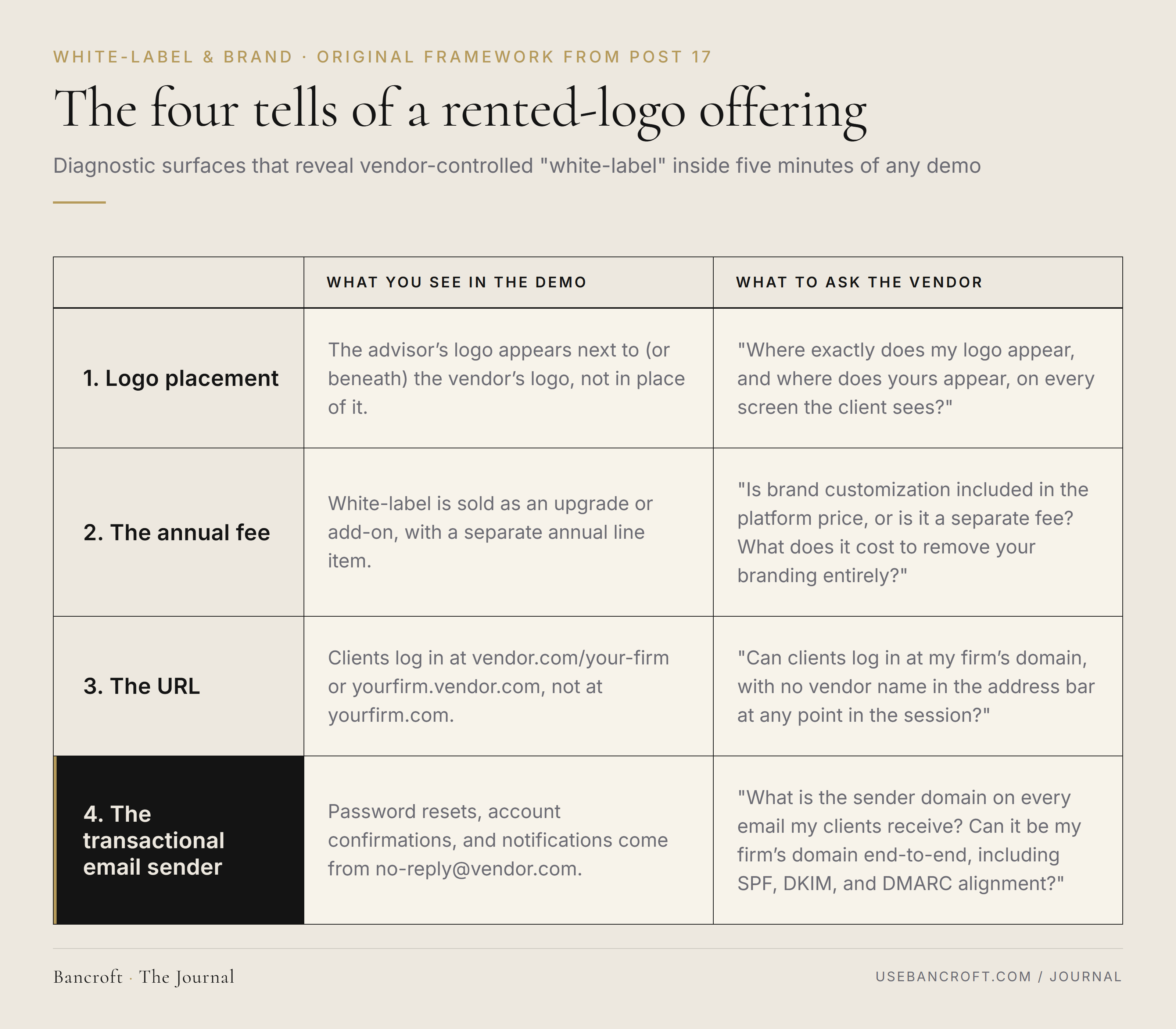
A vendor that hesitates on any of these four questions is selling rented logos. A vendor that answers each one with a clean "yes, your domain, your logo, no vendor surface" is shipping real white-label.
Why vendors call it white-label anyway
"White-label" is the most-abused word in advisor tech. The original definition (a product manufactured by one company that another company sells under its own brand, with the manufacturer invisible to the end customer) is clean and unambiguous. The category usage in 2026 is loose enough to mean anything from a custom logo upload to a full domain-and-brand takeover.
The looseness is not accidental. Vendors discovered that "white-label" is the buzzword that closes advisor sales, and they used it whether the offering matched the definition or not. The largest player in the consumer estate planning category does not even sell a white-label product, because their model is direct-to-consumer brand-building and the vendor brand IS the product. The few category players that do sell white-label typically sell the rented-logo version: the vendor brand stays in the experience, the advisor pays an annual fee for the logo upload, and the marketing copy says "fully white-labeled."
There is a simple incentive explanation. Every minute a household spends inside a vendor-branded experience is a minute the vendor builds brand equity inside the advisor’s book. That brand equity is the vendor’s growth flywheel. Real white-label, in which the vendor disappears entirely, gives that flywheel up. Vendors with the most to lose from real white-label are the loudest about how white-labeled their product already is.
You can read the asymmetry in the demo. Vendors that ship real white-label demonstrate it by walking through every surface a client touches. Vendors that ship rented logos show the upper-left corner of one screen and move on.
The history of the term is worth a sentence. "White-label" originated in consumer-packaged-goods manufacturing in the 1970s, where a contract manufacturer would produce the product and the retailer would put their own brand on it. The manufacturer was invisible to the customer; the retailer owned the entire shelf experience. The term migrated into software in the 2000s and was applied loosely from the start. By the time it reached advisor tech in the 2010s, the definition had eroded enough that any vendor with a logo upload could claim it. The category has been operating with the eroded definition ever since.
The two costs of renting your logo
The rented-logo model imposes two costs on the advisor. The first is direct and measurable. The second is invisible until you add it up across a decade.
Cost one: the annual fee
Vendors typically price the white-label upgrade as a separate annual line item, on top of the platform subscription. The amount varies by vendor and by tier; it is rarely free, and it is sometimes priced per advisor seat in a multi-advisor firm. The line item is the rent. The advisor pays it for the privilege of having the firm’s logo appear on a vendor-controlled experience that the client recognizes as the vendor’s.
You can rationalize the rent in isolation. The amount feels small relative to the platform’s utility, and the alternative is no branding at all. The problem is that the rent is the cheap cost. The expensive cost is the second one.
Cost two: brand-equity erosion
The hidden cost of brand interruption is the longer treatment of this argument; the short version: every vendor-brand surface a client encounters in a "white-label" portal is a sub-threshold trust event that compounds across a decade of household interactions. The brain registers each one. The household does not consciously notice. Over 100 to 150 sessions and tens of thousands of micro-impressions, the vendor accrues brand equity in the household’s mind that the advisor paid for and does not own. When the household refers a friend, they sometimes refer the vendor instead of the advisor. The advisor never finds out the referral was lost; it just never arrives.
The compounding nature of this cost is what makes it expensive. The annual fee is paid once a year and feels small. The brand-equity erosion is paid every session and feels invisible. Over the lifetime of an advisor relationship, the second cost typically dominates the first by an order of magnitude.
What real white-label actually looks like
Real white-label means the vendor disappears. The household never sees the vendor brand at any point in any session, on any surface, in any email, on any document. The advisor brand is the only brand the household associates with the experience. The engineering required to deliver this is meaningfully different from the engineering required to upload a logo.
The architectural surface area looks roughly like this. The portal runs on the advisor’s domain (yourfirm.com or portal.yourfirm.com), with multi-tenant DNS and per-tenant SSL provisioned automatically. The portal’s color, typography, logo, favicon, and login screen reflect the firm. The transactional emails come from the firm’s sender domain with full SPF, DKIM, and DMARC alignment so the client’s email client renders the firm name in the inbox preview. Generated PDFs carry the firm’s metadata. Public-facing legal pages (privacy policy, terms) appear on the firm’s domain. The vendor surface is excluded from the entire client experience. The rented-logo model minimizes that surface; real white-label removes it.
On Bancroft, this is what the Firm tier ships. Custom domain (yourfirm.com or any subdomain), branded portal with the firm’s colors / typography / logo / favicon, multi-tenant DNS automation, per-tenant SSL provisioning, and the AdvisorBrandProfile model that resolves the firm brand at the middleware layer for every authenticated request. Every advisor on the platform gets a branded subdomain by default; the Firm tier moves it to a custom domain and adds the full surface ownership. Real white-label, end to end, with no annual upgrade fee for the privilege of branding.
The five-tier white-label spectrum that organizes this conversation, including which surfaces matter at which tier, is in our spectrum essay. The behavioral-economics case for spending the engineering to ship real white-label rather than the rented-logo model is in the brand interruption piece.
What to do if you are already on a rented-logo platform
Most advisors who care about this question discover it after they have already signed with a vendor and rolled the platform out to clients. The migration cost feels prohibitive in the abstract. The real migration cost is meaningfully lower than it looks, because the brand-equity erosion the rented-logo model creates is itself the main cost the migration is trying to stop.
The practical move is a four-step audit.
- Inventory the surfaces. Walk every surface a client touches on the current platform: the login URL, the password-reset email, the receipt for any add-on purchase, the PDF metadata in any downloaded document, the privacy-policy link in the portal footer. Document where the vendor brand appears.
- Ask the incumbent in writing. Ask what it would take to remove every vendor surface from the client experience. The answer is usually some combination of "not available on your tier" and "available as a custom enterprise contract for an additional annual fee."
- Ask a real white-label competitor the same question in writing. Compare the two answers side by side.
- Price the status quo. Calculate the all-in cost of the rented-logo model over a five-year horizon, the annual fee plus a conservative estimate of brand-equity erosion at one to two percent of book retention, against the migration cost of moving to a real white-label platform.
That fourth step is the one advisors skip, and it is the one that changes the decision. The math usually does not require a spreadsheet.
The migration itself is operationally simpler than it looks. Households are accustomed to advisor platform changes; the transition is a one-time email and a re-login. The harder part is internal: rebuilding the firm’s muscle memory around the new portal, retraining the assistant or paraplanner who runs the client-side workflow, and updating any client-facing collateral that references the old portal URL. None of that takes more than a quarter, and the work pays for itself the first time a household refers a friend who lands at the firm’s domain instead of the vendor’s.
What this means for advisor brand strategy
Brand is the asset that compounds the slowest and produces the largest payoff late in the advisor’s career. Every household interaction either builds the firm brand or builds a vendor brand inside the firm’s book. There is no neutral interaction. The rented-logo model loses the slow-compounding asset to the vendor every session. Real white-label keeps it.
A worked example clarifies the math. An advisor with 80 households running a typical estate-planning workflow will produce roughly 8,000 to 12,000 client-facing portal sessions over a decade. Add the transactional emails (account confirmations, password resets, document-ready notifications, annual review prompts), the PDF documents the household downloads, the receipts for any add-on purchase, the public legal pages a client occasionally clicks. Conservatively, the firm produces somewhere north of 50,000 vendor-brand impressions over ten years on a rented-logo platform. On real white-label, that figure is zero. The household sees the firm 50,000 times. The household sees the vendor zero times. Compounded across the next-generation referral window, the difference is the difference between a firm that the children of the original clients call when their parents die and a firm that the children Google and discover the vendor instead.
You can think of the choice as a long-dated trade. The rented-logo model is cheap to enter and expensive to exit. The advisor pays an annual fee that feels reasonable in year one and discovers in year ten that the vendor has accrued brand-recognition equity inside the firm’s book that the advisor paid to build. Real white-label is more expensive to ship for the vendor (which is why most vendors skip it) and meaningfully more valuable to own for the advisor across a career.
If you are evaluating an estate planning platform and the vendor uses the phrase "white-label," the work is to test the four tells in the table above. A vendor that passes all four cleanly is shipping real white-label. If the vendor passes one or two and equivocates on the others, that is rented logos with a marketing-copy makeover.
The brand on the portal is the brand the household will refer to when they tell their friends. Make sure the brand is yours.
Before signing, put the four questions above to the vendor in writing: where each logo appears, what the branding fee covers, what URL clients visit, and what domain the transactional emails come from. The answers are checkable facts, and a vendor selling a rented logo cannot answer all four cleanly.
Read next
What white-label actually means in advisor tech
White-label is the worst-defined word in advisor tech. Five distinct tiers, most platforms at the bottom two, and where each model breaks.
White-Label & BrandThe hidden cost of brand interruption in advisor tech
Every vendor logo a client sees in a white-label advisor portal creates a small doubt. Small doubts compound. Here is the real cost across a decade.
Trust FundingWhy most revocable trusts are never funded
Most revocable trusts are never properly funded. The signing meeting feels like the finish line. Funding is where the plan actually fails, and why.
Frequently asked questions
What is the rented-logo model in advisor white-label?
The rented-logo model is the dominant pattern in advisor estate planning marketed as "white-label." The vendor adds the advisor’s logo to the upper corner of a vendor-controlled portal, charges an annual fee for the customization, and keeps every other client-facing surface (URL, email sender, PDF metadata, legal pages, login screen, support footer) under the vendor’s brand. The advisor pays for branding that the client recognizes as the vendor’s anyway. Marketing copy still calls this "fully white-labeled."
How can I tell whether a vendor offers real white-label or rented logos?
Four diagnostic tells. (1) Where the advisor logo appears: alongside the vendor logo or in place of it? (2) Whether brand customization is part of the base platform price or a separate annual line item. (3) What domain the client sees in the address bar: yourfirm.com or vendor.com/your-firm. (4) What sender domain the transactional emails come from: your firm’s domain with SPF/DKIM/DMARC alignment, or no-reply@vendor.com. A vendor that answers each one cleanly with the firm’s domain and the firm’s logo (no vendor surface) is shipping real white-label. A vendor that hesitates is selling rented logos.
Why do vendors keep calling rented-logo offerings "white-label"?
"White-label" is the buzzword that closes advisor sales, and the term has loosened in category usage to mean almost anything that includes a logo upload. The second is that vendors with the most to lose from real white-label (the brand-equity flywheel that comes from putting the vendor brand inside every advisor’s book) are the loudest about how white-labeled their product already is. Real white-label gives up that flywheel; the rented-logo model preserves it.
What does Bancroft’s white-label actually include?
Bancroft’s Firm tier ships full white-label end to end: custom domain (the firm’s own yourfirm.com or any subdomain), branded portal with the firm’s colors, typography, logo, and favicon, multi-tenant DNS automation, per-tenant SSL provisioning, and an AdvisorBrandProfile model that resolves the firm brand at the middleware layer for every authenticated request. Every advisor on Bancroft gets a branded subdomain by default; the Firm tier moves it to a custom domain and adds the full surface ownership. There is no annual upgrade fee for the white-label work; it is the Firm tier itself.
How much does the rented-logo model cost an advisor over time?
Two costs. The first is the direct annual fee the vendor charges for the white-label upgrade, which is small relative to the platform subscription and feels reasonable in isolation. The second is brand-equity erosion: every vendor-brand surface a client encounters in a "white-label" portal is a sub-threshold trust event that compounds across a decade of household interactions. Over 100 to 150 sessions per household, multiplied across the advisor’s book, the vendor accrues recognition equity inside the firm’s book that the advisor paid to build. Households sometimes refer the vendor instead of the advisor; the advisor never finds out a referral was lost. The second cost typically dominates the first by an order of magnitude over a career.
Share this essay