Jump to section
- The seventy percent figure is widely misread
- The inheritance default
- The four prerequisites of inheritance default
- The 90-day handoff window
- The first seventy-two hours
- The trust administration period (months 1 to 3)
- The consolidation conversations (months 3 to 12)
- How Bancroft handles the operational layer
- The bottom line
Roughly seventy percent of investment-management relationships end at the first-generation event. The number is the most-cited figure in advisor practice management, and the interpretation almost everywhere is that the inheriting children chose to fire the advisor at the moment of transfer. The interpretation is wrong. The children did not fire the advisor on the morning the parents died. The advisor was never the default destination for the inheritance conversation in the first place. The conversation routes by default to whoever has been the operational center of the household’s estate matters for years, and the routing was set long before anyone made the first call. This piece is about how to be that default destination.
The seventy percent figure is widely misread
Industry estimates put the first-generation breakage rate at roughly 70 percent of investment-management relationships at the moment of transfer (commonly cited figure across Cerulli Associates and adjacent practice-management literature). Two-thirds of the AUM the firm spent decades earning walks out the door at the wealth-transfer event. The figure is real. The interpretation is what gets misread.
The conventional read is that the inheriting children met the firm for the first time at the wake and decided the firm was not their kind of operation. A different advisor, more aligned with the next-generation client profile, picked up the call. The implication is that the firm could have prevented the breakage by being more next-generation-friendly: a better digital portal, a younger advisor on the relationship, a softer aesthetic.
That read overweights the moment of transfer and underweights everything that happened before it. The morning the parents died is the worst possible moment to make a fiduciary-level decision about consolidating inherited assets, and the children make no such decision then. What actually happens is operational: the executor calls whoever has the documents, the trust administration attorney needs the funded-document set, the surviving spouse looks for the person who has been running the household’s financial coordination for years. The call lands wherever the routing was already set, long before anyone died.
Two readings of the same seventy percent
When the decision is made
The conventional read
At the wake, by children meeting the firm for the first time.
What actually happens
Years earlier, by whoever became the operational centre of the household’s estate matters.
What drives it
The conventional read
Fit. The firm reads as the parents’ generation, not the children’s.
What actually happens
Routing. The executor calls whoever holds the documents.
What the firm could have changed
The conventional read
Its aesthetic, its digital portal, the age of the lead advisor.
What actually happens
Whether it was present at four specific operational moments.
When it is too late
The conventional read
Never, in theory. There is always the reconnect meeting.
What actually happens
The morning of the death. The routing is already set.
The inheritance default
The inheritance conversation has a default destination for every household. The default is a structural property of the household’s relationships at the moment of death, not a choice made at the moment of death. The default destination is the firm that has been operating the household’s estate matters across the relationship: the funding ceremony at engagement, the annual review meetings, the amendment coordination when life events surfaced, the document vault where the executor knows the funded plan lives.
The firm that meets that profile receives the inheritance conversation by default. The firm that meets none of it does not, no matter how strong the AUM relationship with the parents was. Default destination is the framework that determines first-generation retention. Asking the children to choose the firm after the parents die is the wrong question; the question is whether the firm has already become the default before the parents die.
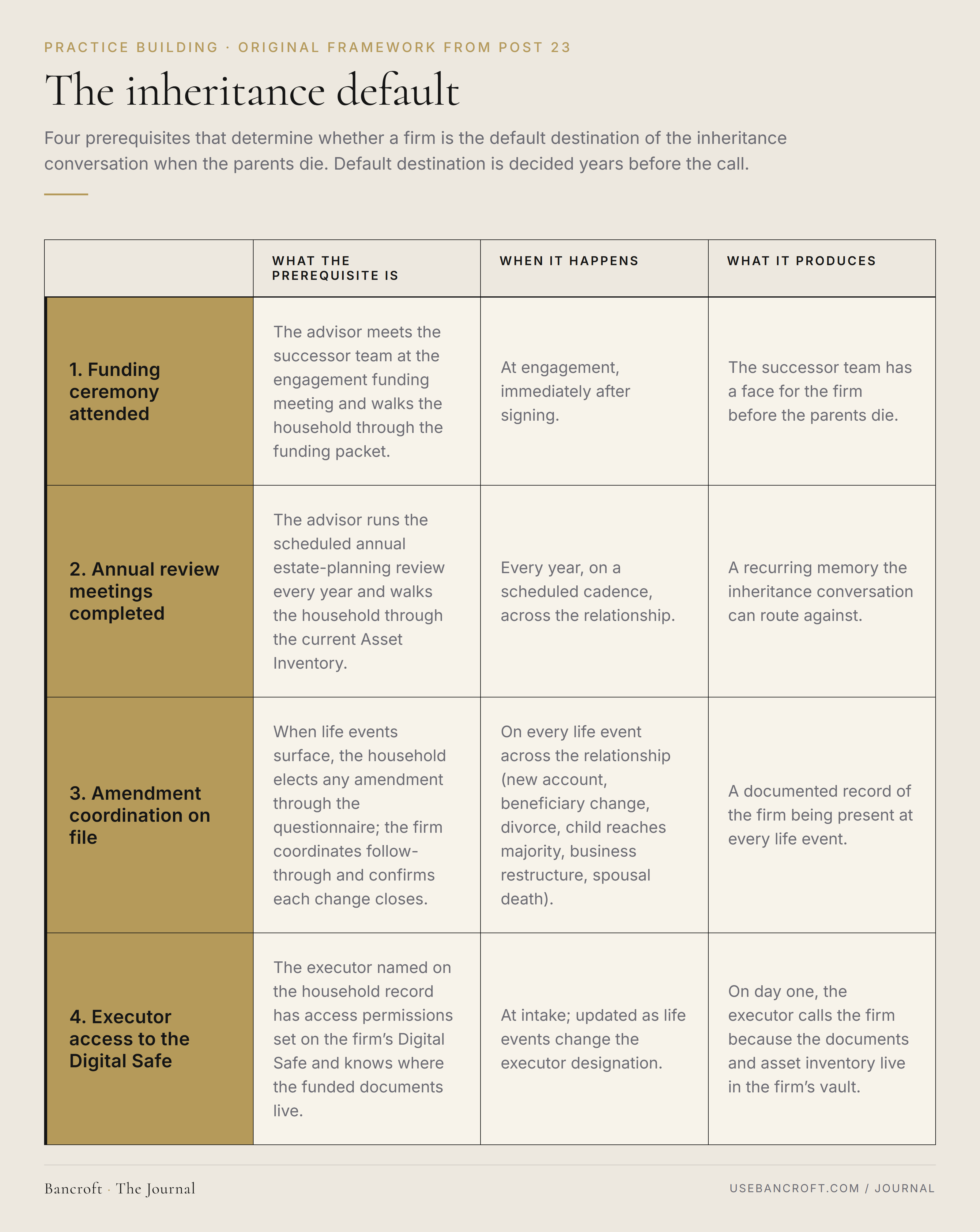
The prerequisites are operational. None of them require the firm to be the next-generation-friendly aesthetic the conventional read prescribes. None of them require a younger advisor on the relationship. They require only that the firm has been present in the household’s estate matters across the relationship in the four specific places where presence translates into default-destination status.
The four prerequisites of inheritance default
1. The funding ceremony attended
The funding ceremony is the meeting where the funding packet is delivered, the first letters go out, and the successor team meets the advisor. This is the moment that names the firm to the next generation. The argument for why the funding ceremony is structurally the wealth-transfer-introduction moment is in our prior piece on funding as the wealth transfer moment. The operational consequence for inheritance default: a successor team that met the advisor at the funding ceremony has a face for the firm years before any death. A successor team that has never met the advisor reaches for a stranger when the call has to be made.
2. Annual review meetings completed
The scheduled annual estate-planning review is the recurring touchpoint that keeps the firm present in the household’s estate matters across the relationship. Most firms do not run a separate annual estate-planning review; the maintenance layer of the estate-planning revenue stack covers exactly this work, and the rationale is in our prior piece on the estate-planning revenue stack. The operational consequence for inheritance default: a household that has experienced the firm running the scheduled annual review every year for a decade has built the recurring memory the inheritance conversation routes against. A household that has experienced no recurring estate-planning touch with the firm has no memory to route against.
3. Amendment coordination on file
Life events happen. New accounts open. Beneficiary forms change. Children reach majority. Spouses die. Businesses restructure. Each life event is a moment where the household elects whether to amend the plan, and the firm’s presence in that election is what becomes the record. The household elects the amendment through the questionnaire-driven workflow; the platform generates the amendment; the firm coordinates the follow-through. The operational consequence for inheritance default: the firm that was present at every life event has a documented record of being the operational center across the household’s estate-planning life. The firm that was not has no record to point to.
4. Executor and beneficiary access to the Digital Safe
The executor named on the household record needs to know where the funded documents live on the morning of the death. The Digital Safe is the vault. The executor and beneficiaries the household named at intake (and updated through the workflow as life events surfaced) need access permissions on file and the operational knowledge of how to retrieve documents on day one. The operational consequence for inheritance default: an executor who calls the firm because the funded plan lives in the firm’s vault routes the inheritance conversation to the firm automatically. An executor who never had access permissions and never knew where the documents lived calls someone else.
The 90-day handoff window
Once the parents die, the inheritance conversation has a finite window in which the consolidation decision lands. The window runs roughly 90 days from the date of death, sometimes longer for complex estates. Inside the window, the decision-tree is operational, not relational: the executor opens probate or activates the trust, the trust administration attorney engages, the beneficiary forms get filed at the institutions, the funded assets move to the named successors, the new household records get opened. By day 90, most of the operational handoff has either landed at the original firm or routed elsewhere.
The window is short because every operational decision runs under time pressure: the trust administration attorney needs the funded-document set immediately, the surviving spouse needs survivor-benefit work coordinated within weeks, and beneficiary claims at institutions like Schwab or Vanguard need to be filed before account-freeze policies create friction. Each decision routes to the firm that already has the records, or routes away from it. The firm that did the four prerequisites finds the decisions routing back automatically; the trust administration attorney calls the firm for the funded-document set, the surviving spouse calls because the firm has been running the household’s estate matters for years, and the beneficiary forms get filed against the asset inventory the firm has been maintaining. By day 90, your firm is either the consolidation default for any inherited account that has not been directed elsewhere, or it is not.
The first seventy-two hours
The advisor’s work in the first 72 hours after death is operational. The family calls the firm. The advisor takes the call, expresses condolence, schedules a working meeting with the executor for the following week, and makes three immediate-term introductions.
- The trust administration attorney. Almost always a $299 attorney-review-routing matter under the platform’s standard rubric, except in the most complex estates, which route to a longer-form estate counsel engagement.
- A CPA or tax preparer, if the family does not already have one.
- A grief or funeral resource, if the family asks. Offered, never pushed.
The advisor does not, in the first 72 hours, do legal work on the estate. The advisor does not advise the executor on which probate filing applies, does not interpret the trust language for the family, does not tell the heirs what their inheritance entitlements are, does not file documents with the court. Each of those is the trust administration attorney’s work. The advisor’s role is to introduce the attorney, provide the funded-document set from the Digital Safe (with proper executor authorization), and stay in the operational loop as the work runs.
The single most important move in the first 72 hours is the attorney introduction. The platform routes a defined-scope estate-administration question through the standard $299 attorney-review tier; complex estates route to a longer-form estate-counsel engagement. The advisor stays adjacent to the work, schedules follow-through meetings, and operates the coordination layer between the executor, the attorney, and the institutions that will need beneficiary forms or account-titling changes.
The trust administration period (months 1 to 3)
The trust administration period is the legal work of marshaling the estate, paying debts, filing tax returns (estate income tax, final personal income tax, estate tax if applicable), and distributing assets to beneficiaries. This work is the trust administration attorney’s, end to end. The advisor’s role is operational coordination: scheduling the meetings, providing documents from the Digital Safe, confirming that beneficiary-form filings have been received by the institutions, and chasing follow-through where institutional processes have stalled.
The coordination work is non-trivial. A typical estate involves five to fifteen institutions (banks, brokerages, retirement custodians, insurance carriers, transfer agents for closely-held interests). Each has its own form, its own processing timeline, and its own definition of acceptable executor documentation. The attorney is the legal authority on what gets filed; the advisor runs the operational follow-through to confirm each filing lands and each beneficiary claim closes. The funded-document set in the Digital Safe is the source-of-truth that makes the coordination work possible.
Stay operational.
Do not narrate the legal mechanics to the family in your own voice; let the attorney narrate. Do not advise on tax consequences of distributions; the CPA owns that. Do not interpret what the trust says about who gets what; the attorney owns that. Run the operational layer underneath the legal work, and your firm becomes the practical center of the trust administration period without doing any of the legal work itself.
The consolidation conversations (months 3 to 12)
Once the trust administration period closes, the inherited assets have been distributed (or are scheduled to distribute) to the named beneficiaries. The consolidation question lands here: each beneficiary decides where the inherited assets live going forward. The firm has the operational presence with the household across the entire administration period and has the relationship-track-record to ask for the business. The firm that did the four prerequisites finds the conversation easy. The firm that did none of them does not.
The conversation is direct. Ask for the business. Walk each beneficiary through the firm’s offering for the inherited assets, the relationship terms, the investment-management approach, and the estate-planning service the beneficiary now needs for their own household. The retention payoff lands in this conversation, which the firm gets to have because it was already the operational center of the parents’ estate matters.
Some beneficiaries consolidate. Some do not. The base rate of breakage is roughly 70 percent without the prerequisites; firms that have done the prerequisites see breakage in the 30 to 50 percent range, sometimes lower. Even a partial reduction is consequential. For a 100-household RIA at $1.5 million average AUM, dropping breakage from 70 to 40 percent on the cohort that hits a first-generation event preserves roughly $45 million of AUM that would otherwise have walked.
How Bancroft handles the operational layer
The platform handles the document, vault, and inventory layer that the inheritance default rests on. The advisor handles the relationship and the operational coordination.
The Asset Inventory captures every household asset and every named person (grantors, successor trustee, named guardians, executor, remainder beneficiaries) with funding strategy per asset. The Funding Letter Automation generates the packet across six approved categories (BANK, BROKERAGE, RETIREMENT, LIFE INSURANCE, BUSINESS INTERESTS, SAFE DEPOSIT). The Digital Safe (always-included on every tier as of the 2026-05-04 pricing change; no per-household charge) stores executed documents, the funded-document set, proof-of-filing uploads, and configurable executor and beneficiary access. The audit log records every document generated, every advisor approval, every proof upload.
On the inheritance default specifically, the Digital Safe is the structural prerequisite you need to configure for every household. The executor named on the household record needs access permissions set at intake and updated through the workflow as life events surface. When the death happens, the executor calls the firm because the documents and asset inventory live in your vault and the executor has known for years that this is where to start. Wellness check-in features inside the Digital Safe can flag a missed check-in and notify named beneficiaries, surfacing the death event into your workflow without depending on the family to make the first call.
On the trust administration period, the platform’s contribution is the funded-document set and the Asset Inventory the trust administration attorney needs to start work. The $299 attorney review tier routes defined-scope estate-administration questions to a licensed attorney; longer-form post-death estate counsel runs as a separate attorney engagement on the household’s file. The funding-letter mechanics are on the funding letters page; the underlying funding-rate problem is in our prior piece on why most trusts are never funded; the multi-advisor build is at /for-enterprise.
The bottom line
The inheriting children do not decide whether to fire the advisor on the morning the parents die. The inheritance conversation routes by default, and the default is decided long before the call. Four prerequisites determine the default for any household: the funding ceremony attended, annual review meetings completed, amendment coordination on file, and executor access to the Digital Safe configured. A firm that meets all four is the default destination. A firm that meets none is not.
The seventy percent breakage figure is the rate at which firms that did none of the prerequisites lose households at transfer. Firms that did the prerequisites cut the rate by half or more. The work is operational presence at four specific moments, and it determines whether the firm is at the wake.
By the time the call comes, the routing has already been set.
This essay is general practice-management commentary. It is not legal or tax advice and does not create an attorney-client relationship. The legal work of the trust administration period is the trust administration attorney’s responsibility; specific questions about estate administration, probate, or tax in any jurisdiction should be confirmed with counsel licensed in that jurisdiction.
Read next
Why funding is the wealth transfer moment
The signing ceremony is not the next-generation introduction moment. The funding meeting is. Here is the math, the mechanic, and the playbook.
Practice BuildingThe estate-planning revenue stack advisors miss
Estate-planning work produces three revenue layers. Most firms invoice only the first. Worked math for a 100-household RIA at 30 percent capture.
Trust FundingWhy most revocable trusts are never funded
Most revocable trusts are never properly funded. The signing meeting feels like the finish line. Funding is where the plan actually fails, and why.
Frequently asked questions
What is the inheritance default?
The inheritance default is the firm that the inheritance conversation routes to by default when the parents die. Default destination is a structural property of the household’s relationships at the moment of death, not a choice made at the moment of death. Four prerequisites determine the default for any given household: the funding ceremony attended (the successor team met the advisor at the engagement funding meeting), annual review meetings completed (the household experienced the firm running the scheduled estate-planning review every year), amendment coordination on file (the firm was present when life events surfaced and the household elected amendments through the questionnaire), and executor and beneficiary access to the Digital Safe configured (the executor knows the funded documents and asset inventory live in the firm’s vault). A firm that meets all four is the default destination. A firm that meets none is not.
Why do investment-management relationships break at the first-generation event?
Industry estimates put the breakage rate at roughly 70 percent of relationships at the moment of transfer. The conventional read is that the inheriting children chose to fire the advisor because the firm was not aligned with the next-generation client profile. That read is wrong. The children do not assess the firm on the morning the parents die; the morning the parents die is the worst possible moment to make a fiduciary-level decision about consolidation. What actually happens is operational: the executor calls whoever has the documents, the trust administration attorney needs the funded-document set, the surviving spouse looks for the person who has been running the household’s financial coordination for years. The call lands wherever the routing was already set, and the routing was set long before the death.
What does the advisor do in the first 72 hours after death?
The advisor’s work in the first 72 hours is operational, not legal. The advisor takes the call, expresses condolence, schedules a working meeting with the executor for the following week, and makes three immediate-term introductions: the trust administration attorney (almost always a defined-scope $299 attorney-review-routing matter, except in the most complex estates), a CPA or tax preparer if the family does not already have one, and a grief or funeral resource if asked. The advisor does not in the first 72 hours interpret the trust for the family, advise on probate filings, tell the heirs what their inheritance entitlements are, or file documents with the court. Each of those is the trust administration attorney’s work.
What is the 90-day handoff window?
The 90-day handoff window is the period after death in which the operational decisions about the estate (open probate or activate the trust, file beneficiary claims at institutions, distribute funded assets to named successors, open new household records) land at the firm or route elsewhere. The window is short because the inheriting family is making operational decisions under time pressure (the trust administration attorney needs the funded-document set immediately; Medicare and survivor-benefit work has to be coordinated within weeks; beneficiary claims at institutions need to be filed before account-freeze policies create friction). By day 90, most of the operational handoff has landed. The firm that did the four prerequisites finds the operational decisions routing back automatically; the firm that did none of them finds the decisions routing elsewhere.
How does Bancroft handle the operational layer of the inheritance handoff?
The platform handles the document, vault, and inventory layer the inheritance default rests on. The Asset Inventory captures every household asset and every named person (grantors, successor trustee, executor, remainder beneficiaries) with funding strategy per asset. The Funding Letter Automation generates the funding packet across six approved categories. The Digital Safe (always-included across every tier; no per-household charge) stores executed documents, funded-document records, proof-of-filing uploads, and configurable executor and beneficiary access. A wellness check-in inside the Digital Safe can flag a missed check-in and notify named beneficiaries. The $299 attorney review tier routes defined-scope estate administration questions to a licensed attorney; longer-form post-death estate counsel engagements run through a separately-engaged attorney on the household’s file. The advisor handles relationship coordination and the operational follow-through; the platform handles the document, vault, and inventory layer.
Share this essay