Jump to section
- The three layers of the stack
- Layer 1: engagement (one-time per household)
- Layer 2: maintenance (recurring per household, per year)
- Layer 3: retention (the AUM preserved through wealth transfer)
- The capture rate (the multiplier most firms never measure)
- The worked example: 100-household RIA at maturity
- Why most firms only price one layer
- How Bancroft handles the work the advisor is pricing
- The bottom line
A 100-household RIA can capture between $250,000 and $500,000 in incremental annual revenue from estate-planning service work by year three. Most do not. The miss is not that households would refuse the bill. Households expect to pay for a real estate plan. The miss is that estate-planning service work produces three layers of revenue stacked on top of one another, and most firms only invoice the first layer. The second layer goes unbuilt. The third layer goes uncounted. This piece walks through the estate-planning revenue stack, the capture-rate multiplier that determines how much of the stack actually shows up, and the worked math for a typical RIA running the full stack at maturity.
The three layers of the stack
Most advisors think of estate-planning service revenue as one line: a project fee per household. The household pays $2,500 at engagement, the documents get generated and signed, the file closes, and the firm moves on to the next household. That model captures about one-third of the revenue actually available, and it leaves the largest dollar component of the opportunity (the AUM that stays at the firm through the first-generation wealth-transfer event, against Cerulli Associates’ $124 trillion total transfer through 2048) on the floor.
The full stack has three layers. Each layer has its own time horizon, its own pricing logic, and its own visibility profile. Each layer pays back differently. The firms that capture all three are the firms that treat estate planning as a service line with the same economic structure as financial planning or tax prep, not as an add-on bolted to the AUM relationship.
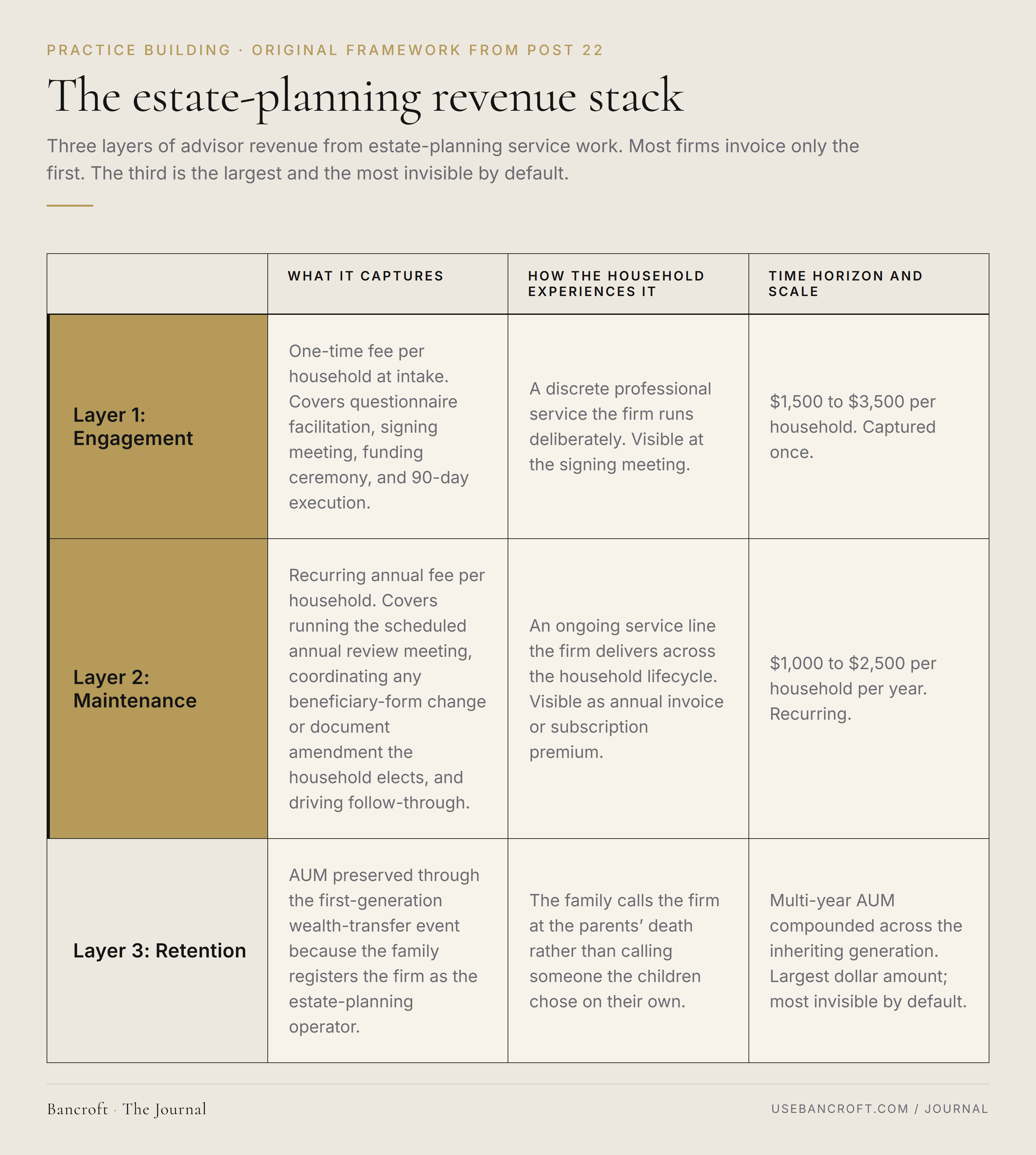
The visibility ordering matters. Layers 1 and 2 are visible by default if the firm chooses to invoice them. Layer 3 is invisible by default and depends on layers 1 and 2 being visible enough that the family registers the work. Pricing the stack is a sequencing problem: layers 1 and 2 build the conditions under which layer 3 actually arrives.
Layer 1: engagement (one-time per household)
The engagement layer covers the work of taking a household from zero to a fully executed and funded estate plan. Industry benchmarks for the underlying advisor work run $1,500 to $3,500 per household at engagement, depending on practice model and household complexity. The flat fee covers the questionnaire facilitation, the signing meeting, the funding ceremony, and the 90-day post-signing execution.
A worked breakdown. Two to three meetings to run the platform questionnaire with the household, capture the asset inventory, and walk through the document set: roughly 4 to 6 hours of advisor time. A signing meeting with witnesses and a notary present where the advisor leads the household through each document: 60 to 90 minutes. A funding ceremony where the funding packet is delivered and the first letters get mailed: 60 to 90 minutes. Four 90-day touchpoints to chase letters through to confirmation: another 3 to 4 hours. The full engagement totals 10 to 14 hours of advisor time spread across roughly 90 days.
At a planning-grade billable rate of $200 to $400 per hour, the engagement work justifies a $1,500 to $3,500 flat fee on a billable-hour basis alone, before any consideration of retention payoff. Practices that invoice this layer separately are charging for work the household visibly receives. Practices that absorb it into the AUM fee are charging for the same work in a form the household does not register.
The legal framing for this layer was covered in our piece on the four-category advisor billing model. Layer 1 maps to questionnaire facilitation plus workflow operation in that taxonomy. The pricing modality (project versus embedded) was covered in our piece on the four-mode trust-funding pricing ladder. What this layer adds to those pieces is the dollar size of the layer in isolation: $1,500 to $3,500 per household, captured once, visible at the signing meeting.
Layer 2: maintenance (recurring per household, per year)
The maintenance layer is where most firms leave money on the floor. Industry benchmarks for the underlying work run $1,000 to $2,500 per household per year, covering the work below.
- A scheduled annual review meeting that the advisor runs.
- An operational check on the funding-letter packet that went out at engagement.
- Follow-through on any amendment or beneficiary-change form the household elects in that meeting.
- The coordination work between meetings, as life events surface (new account, beneficiary change, divorce, child reaches majority, business restructure, spousal death) and route back through the questionnaire-driven workflow.
None of that is exotic.
The work is real. A typical household has one or two life events per year that the advisor should be checking in about. The platform schedules the annual reminder. The advisor runs the review meeting and walks the household through the current Asset Inventory: which accounts exist, what beneficiary forms are on file, what funding letters have closed, what is outstanding. The household identifies any life events and decides whether to elect a beneficiary-form change, a trust amendment, or any other document update; the platform generates any election the household makes through the same questionnaire-driven workflow used at engagement. The advisor coordinates the follow-through and confirms each change closes. None of that work shows up as a separate event on your calendar unless you scheduled it. The annual estate-planning review is the scheduling mechanism that captures the work as deliberate engagement rather than ad-hoc cleanup.
Almost no advisor practice runs a separate annual estate-planning review.
The retainer ranges from $1,000 to $2,500 per household per year, sometimes embedded as additional basis points on AUM (15 to 25 bps for households in the estate-planning service tier) and sometimes invoiced as a flat annual subscription. For an RIA with 100 households on maintenance at $1,500 per year, the layer produces $150,000 in annual recurring revenue. The coordination work was happening anyway; the layer just makes it billable. Without a scheduled annual review and a clear subscription line, the work happens reactively, the household never registers it as a service, and the firm never invoices for it.
Layer 3: retention (the AUM preserved through wealth transfer)
The third layer is the largest in dollar terms and the one most firms never put a number on. The retention layer is the AUM that stays at the firm through the first-generation wealth-transfer event. The mechanism is direct: a household whose estate plan was coordinated through the firm and whose successor team met the firm at the funding ceremony has a relationship with the firm that survives the death of the original grantors. A household whose estate-planning work was absorbed into the AUM fee and never surfaced as deliberate service does not.
Industry estimates put the first-generation breakage rate at roughly 70 percent of investment-management relationships at transfer (commonly cited figure across practice-management literature). For an RIA with 100 households and an average household AUM of $1.5 million, that breakage rate translates to roughly $100 million walking out the door across the wealth-transfer window if nothing changes the default.
Estate-planning households break less. The argument for why is the funding ceremony: the funding meeting is the only moment where the advisor can introduce themselves to the entire successor team in a calm, planned setting. The successor team meets the advisor before the parents die. When the parents do die, the children already know who to call.
A back-of-envelope retention calculation for a 100-household RIA over a decade. Assume the firm runs the full stack on 50 of those households and reduces the breakage rate from 70 percent to 30 percent across that cohort. That is 20 retained next-generation relationships that would have left otherwise. At an average inherited AUM of $1 million per relationship and a 1 percent management fee, the preserved revenue is $200,000 per year across the inheriting generation, compounding as the inheriting households consolidate assets at the firm. Over a decade, the retention layer alone is worth several million dollars to the firm.
Layer 3 is the largest layer in the stack. It is also the one that only arrives if layers 1 and 2 were visible enough that the family registered the work. Firms that absorb layers 1 and 2 into the AUM fee are pricing as if layer 3 will appear automatically. It does not.
The capture rate (the multiplier most firms never measure)
The revenue stack is the per-household opportunity. The capture rate is the multiplier that determines how much of the stack the firm actually realizes. The capture rate is the percentage of the firm’s households that complete a fully funded estate plan in any given twelve-month window.
For a firm with no estate-planning process at all, the capture rate is roughly 5 percent. The number reflects the households that bring their own attorney-coordinated plan in from outside, plus the occasional household that finishes a plan despite the absence of a workflow. For a firm with a real estate-planning workflow (intake protocol, questionnaire facilitation, signing meeting, funding ceremony, 90-day execution, annual review), the capture rate runs 20 to 40 percent per year, depending on practice maturity and household readiness.
The 4-to-8x difference in capture rate is the multiplier on the entire revenue stack. A 100-household firm at 5 percent capture runs 5 households through the engagement layer per year and realizes a small slice of layers 2 and 3 on those 5. The same firm at 30 percent capture runs 30 households through engagement, accumulates the cohort on maintenance, and produces a measurable retention effect across the wealth-transfer window. The work per household is comparable; the throughput is six times larger.
Most firms do not measure the capture rate because most firms have not defined the work crisply enough to count. The KPI that matters is: out of the households who finished a year on your book, what percentage completed a fully funded estate plan in that year? If you cannot answer the question, you are also not running the operational discipline that makes the answer go up.
The worked example: 100-household RIA at maturity
Numbers for a 100-household RIA running the full stack at year three, with a 30 percent annual capture rate.
The stack at maturity for a 100-household RIA at 30 percent capture
| Component | Calculation | Annual revenue at maturity |
|---|---|---|
| Layer 1: engagement | 30 households per year × $2,500 | $75,000 |
| Layer 2: maintenance | 90 households on the maintenance cohort × $1,500 per year | $135,000 |
| Layer 3: retention payback | 8 retained next-generation relationships per year × $1,000,000 inherited AUM × 1.0% fee | $80,000 (compounding) |
| Total at year three | Layers 1 + 2 + 3 | $290,000 |
| Total at year five (full cohort, layer 3 compounding) | Layers 1 + 2 grow with cohort; layer 3 doubles | $450,000 to $500,000 |
Component
Layer 1: engagement
Calculation
30 households per year × $2,500
Annual revenue at maturity
$75,000
Component
Layer 2: maintenance
Calculation
90 households on the maintenance cohort × $1,500 per year
Annual revenue at maturity
$135,000
Component
Layer 3: retention payback
Calculation
8 retained next-generation relationships per year × $1,000,000 inherited AUM × 1.0% fee
Annual revenue at maturity
$80,000 (compounding)
Component
Total at year three
Calculation
Layers 1 + 2 + 3
Annual revenue at maturity
$290,000
Component
Total at year five (full cohort, layer 3 compounding)
Calculation
Layers 1 + 2 grow with cohort; layer 3 doubles
Annual revenue at maturity
$450,000 to $500,000
The math is bottom-up. Layer 1 captures the immediate professional fee. Layer 2 builds the recurring revenue as the cohort grows (year one: 30 households on maintenance; year three: roughly 90, because households stay on maintenance once enrolled). Layer 3 starts small and compounds as the inheriting generation consolidates assets. At full maturity, the three layers combined produce $400,000 to $500,000 per year in incremental revenue on a 100-household practice.
Compare against the embedded-only model: same 100-household practice, same estate-planning work happening, no separate invoice, no maintenance retainer, no measured capture rate. Layer 1 disappears into AUM. Layer 2 happens reactively when life events fire but never gets billed. Layer 3 fails to arrive because the family never registered the work as deliberate service. The firm’s topline is the same as if the work had not happened. The wealth-transfer payoff is the same as if the firm had no estate-planning process at all.
Why most firms only price one layer
Two operational reasons and one conceptual reason. The operational gaps are mechanical: no scheduled annual estate-planning review (so layer 2 has no billing event to attach to) and no tracking on the wealth-transfer cohort (so layer 3 is invisible in the operating data). Both are workflow problems, fixable in a quarter of focused work.
The conceptual reason is harder. Most advisors who add estate planning frame it as a retention bonus rather than a service line. The retention frame says the work is valuable because it keeps the household, the household pays through the AUM relationship, and pricing the work separately would feel like double-charging. The service-line frame says the work produces an outcome the household pays for, the AUM relationship is one revenue stream, estate-planning service is another, and the retention payoff is a third. The first frame collapses three layers into one. The second sees the stack. If you find yourself defending invisible pricing on the grounds that the household already pays through AUM, the retention frame is doing the defending, and it undersizes both the opportunity and the retention payoff it claims to protect.
Revenue you do not name is revenue you do not retain.
How Bancroft handles the work the advisor is pricing
The platform handles the document and workflow layer. The advisor handles the pricing and the relationship.
Layer 1 runs through the household Asset Inventory and the questionnaire workflow. The advisor and household complete intake, the platform generates the document set from attorney-reviewed templates, the advisor leads the signing meeting, and the Funding Letter Automation produces the funding packet across the six approved categories (BANK, BROKERAGE, RETIREMENT, LIFE INSURANCE, BUSINESS INTERESTS, SAFE DEPOSIT). The household downloads the packet from the client portal, marks each letter mailed, and uploads encrypted proof of filing to the Digital Safe vault. A daily reminder cron drives follow-through across the 90-day execution window.
Layer 2 runs through the same components on a recurring schedule. The platform schedules the annual reminder. The advisor runs the review meeting and walks the household through the current Asset Inventory, including the standing beneficiary-designation surface on each account. The household identifies any life events and elects any beneficiary-form change or document amendment; the platform generates the elected output through the same questionnaire-driven workflow used at engagement. Amendments and restatements on Bancroft are free across every tier, a pricing decision driven by exactly this use case: a firm running estate planning as a maintenance service should not face a per-amendment fee that discourages households from keeping the plan current. Complex situations route for $299 attorney review; Lady Bird Deeds receive mandatory $399 attorney review.
Pricing is the advisor’s decision. Bancroft does not bill the household directly for the advisor’s professional time on any layer of the stack. The platform fee structure (Advisor $299 a month, Growth $499 a month, Firm $799 a month plus $249 a month per additional seat) is the advisor’s cost for the platform itself. Whatever the practice invoices the household for engagement, maintenance, or any other layer of the estate-planning service is set by the practice and kept by the practice. The mechanics of the funding-letter packet are on the funding letters page; the solo-planner product page is at /for-solo-advisors; the multi-advisor build is at /for-enterprise.
The bottom line
Three layers, not one. The engagement layer is captured at the signing meeting. The maintenance layer is built across the household lifecycle. The retention layer arrives at the wealth-transfer event, but only if layers 1 and 2 were visible enough that the family registered the work.
The capture rate is the multiplier on the stack. A firm with no process runs at 5 percent and realizes a fraction of any layer. A firm with a real workflow runs at 20 to 40 percent and produces six times the throughput on the same per-household economics. The KPI matters. The firms that measure it are the firms that get it.
Most firms price one layer and leave the other two on the floor. The math is straightforward. The work is real. The decision is whether to name the work so the family registers it, or to absorb it so the family does not.
The plan they paid for is the plan they remember.
This essay is general practice-management commentary. It is not legal advice and does not create an attorney-client relationship. Specific UPL questions about pricing and billing structure in any jurisdiction should be confirmed with counsel licensed in that jurisdiction.
Read next
How to price trust funding as a service
Four modes for charging households for trust-funding work. Why invisible pricing costs the wealth-transfer payoff.
Compliance & UPLThe UPL-safe billing model for estate planning
The four-category invoice taxonomy that lets advisors price the estate-planning workflow cleanly. Why the bill is what the bar reads first.
Practice BuildingWhy funding is the wealth transfer moment
The signing ceremony is not the next-generation introduction moment. The funding meeting is. Here is the math, the mechanic, and the playbook.
Frequently asked questions
What is the estate-planning revenue stack?
A three-layer model of advisor revenue from estate-planning service work. Layer 1 (engagement) captures a one-time fee per household at intake for the questionnaire facilitation, signing meeting, funding ceremony, and 90-day execution, typically $1,500 to $3,500. Layer 2 (maintenance) captures recurring annual fees of $1,000 to $2,500 per household for running the scheduled annual review meeting, coordinating any beneficiary-form change or document amendment the household elects through the questionnaire, and driving follow-through on funding-letter loose ends. Layer 3 (retention) captures the AUM preserved through the first-generation wealth-transfer event because the family registers the firm as the estate-planning operator and calls the firm at the parents’ death. Most firms invoice only the first layer; the third is the largest in dollar terms but the most invisible by default.
How much can a 100-household RIA earn from estate-planning service work?
A worked example at year three with a 30 percent annual capture rate produces roughly $290,000 in incremental annual revenue: $75,000 from layer 1 (30 engagements × $2,500), $135,000 from layer 2 (90 households on maintenance × $1,500), and $80,000 from layer 3 (preserved next-generation AUM, compounding). At full maturity across the wealth-transfer window the combined total can reach $400,000 to $500,000 per year. The same practice running embedded pricing only and no maintenance retainer realizes a small fraction of the same opportunity.
What is the capture rate?
The percentage of the firm’s households that complete a fully funded estate plan in any given twelve-month window. Firms with no estate-planning workflow capture roughly 5 percent. Firms with a real workflow (intake protocol, questionnaire facilitation, signing meeting, funding ceremony, 90-day execution, scheduled annual review) capture 20 to 40 percent. The 4-to-8x difference in capture rate is the multiplier on the entire revenue stack. Most firms do not measure the capture rate because most have not defined the work crisply enough to count.
Why is the third layer the largest if it is invisible?
The retention layer captures the AUM preserved through the first-generation wealth-transfer event. Industry estimates put the breakage rate at roughly 70 percent of investment-management relationships at transfer. For a 100-household RIA with $1.5 million average household AUM, the default breakage is roughly $100 million of AUM walking out the door across the wealth-transfer window. Estate-planning households break less because the family met the firm at the funding ceremony and knows who to call when the parents die. The retention layer is the largest dollar amount in the stack and the one most firms never put a number on, because it only arrives when layers 1 and 2 were visible enough that the family registered the work.
Should the layers be priced separately or bundled?
A hybrid is the right answer for most RIAs: project pricing for layer 1 at engagement to make the initial work visible, plus subscription pricing for layer 2 to make the recurring service visible. Layer 3 is not invoiced directly; it shows up as preserved AUM across the wealth-transfer window. Firms that cannot restructure the fee model to introduce project or subscription components should at minimum make the work visible on the annual statement, with itemized line items naming the engagement and maintenance work as included service so the family registers the work even if the bill does not change.
Share this essay