Jump to section
- Why pricing is a UPL question
- The four-category advisor billing model
- Category 1: Education and conversation
- Category 2: Questionnaire facilitation
- Category 3: Workflow operation
- Category 4: Ongoing maintenance
- What cannot be on the bill: the UPL red flags
- How Bancroft handles the workflow you are pricing
- The bottom line
An advisor can charge fairly for offering estate planning as a service. An advisor cannot charge for the practice of law. The two activities feel close enough to merge in casual conversation. They are not close on the bill. The bill is what the bar reads first if a complaint surfaces.
Most advisors think about UPL at the conversation level and stop there. The pricing matters more, because the pricing is in writing. Here is the four-category advisor billing model, with the UPL guardrails built into the line items rather than bolted on afterward.
Why pricing is a UPL question
Every state UPL framework has two prongs: performing legal services, and holding yourself out as performing them. ABA Model Rule 5.5 prohibits both, and most states track it. The "holding out" prong is where the invoice does its quiet damage.
What you charge for is what you held yourself out as providing. An engagement letter that says "estate plan preparation" holds you out as preparing the estate plan. An invoice line that says "will drafting" holds you out as drafting the will. The bar does not need to prove that any drafting happened. The bar needs to prove that you described the service to the household as drafting, and the document with your firm’s letterhead at the top is the proof.
The bill is also the most easily-discovered evidence in any UPL complaint. A household member who feels the advisor crossed a line produces two documents: the engagement letter and the most recent invoice. Both were written or countersigned by the advisor, both describe the service in writing, and both go straight to the bar’s intake committee. The conversation is hard to prove. The invoice is in a kitchen drawer.
This holds even when the workflow is on the right side of the line. Under the LegalZoom v. North Carolina State Bar consent judgment, document preparation is lawful where the platform shows blank templates pre-purchase, runs every form through state-licensed attorney review, and discloses that the form is not a substitute for legal advice. The workflow is defensible. A bill line calling that workflow legal drafting is not.
The four-category advisor billing model
The invoice describes a service, and it has to be a service the advisor can lawfully provide. Four categories fit. Build the engagement letter and the invoice around them and the pricing model is structurally UPL-safe.
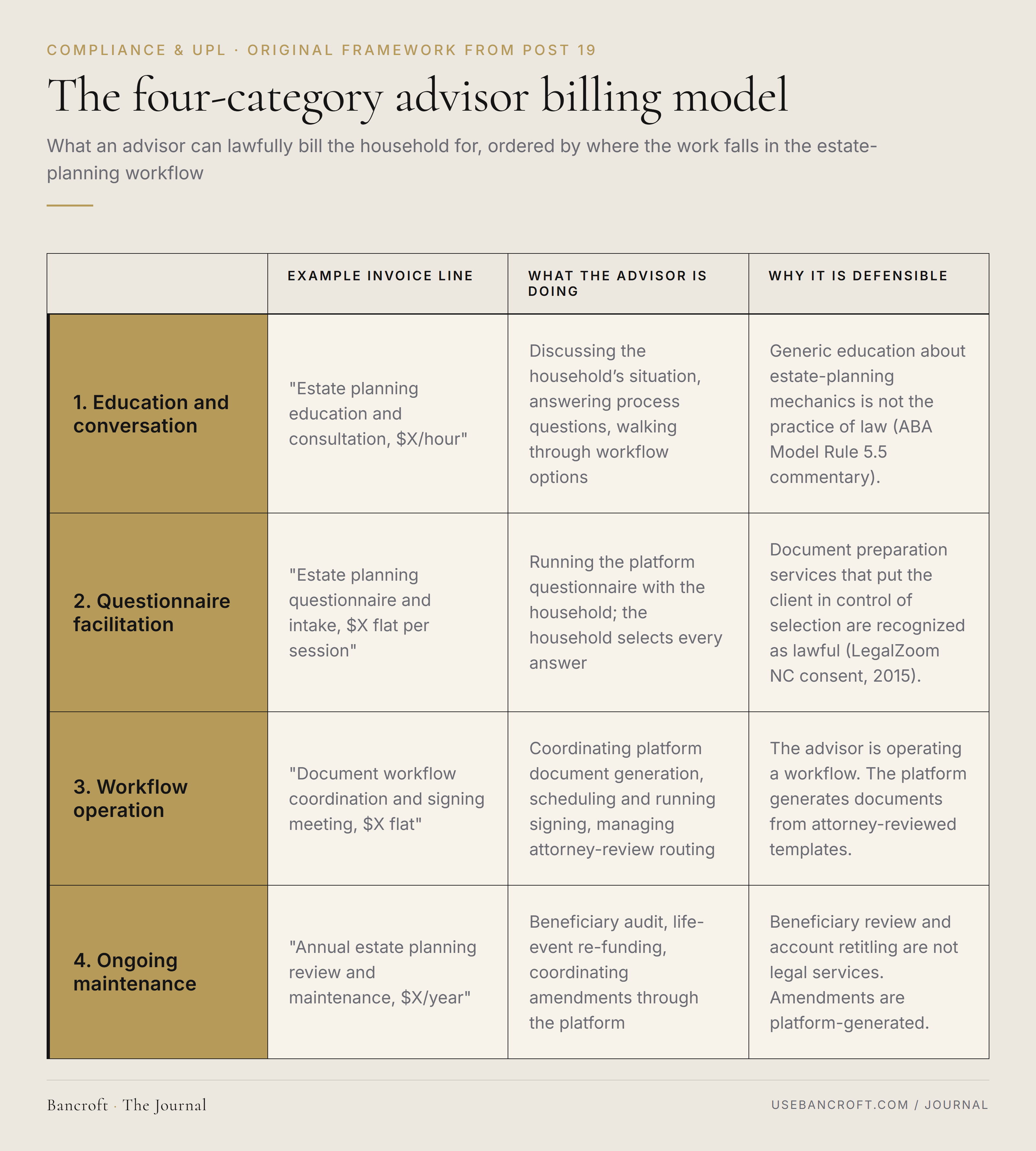
The four categories cover what a typical advisor estate-planning service actually delivers. None of them include drafting, recommending, or selecting documents. The advisor educates, facilitates, operates, and maintains. The household selects through the questionnaire. The platform generates from attorney-reviewed templates. Licensed attorneys reviewed the templates. Each role on the workflow is paid for what they actually do.
Category 1: Education and conversation
The first category is the easiest to bill cleanly because it is the easiest to describe accurately. An education and conversation engagement is what the advisor delivers when a household is at the front of the workflow: the introductory meeting, the second-meeting walkthrough of options, the answer to "what is a Lady Bird Deed and when does it apply," the conversation about what a revocable trust does and when it generally applies.
The work is real. It is also not the practice of law. The legal-tech category has been clear on this point since the Texas legislature’s 1998 Nolo clarification, covered in our piece on the UPL gray zone: generic education about legal mechanics, options, and the workflow itself is not legal advice. Specific advice on which document this household should choose for their situation is. The line falls between the two, and a careful conversation can stay on the right side of it for an entire client engagement.
Bill it as "Estate planning education and consultation," "Estate planning options walkthrough," or "Pre-engagement consultation, estate planning service." Hourly works. Flat fee per session works. Fee-only planners often bill education at $200 to $400 per hour, the same as any other planning conversation.
You will encounter the temptation to write the bill line as "estate plan recommendation" or "trust structure recommendation." Both phrases are legal-recommendation framing and both belong on the wrong side of the line. The advisor does not recommend a specific document for a specific household. The advisor surfaces the household’s facts (assets, beneficiaries, residency, family structure, special situations), describes the workflow’s options, and lets the questionnaire route the household to the documents that fit. The conversation is real work. The recommendation belongs to the platform’s structured questionnaire and the templates the licensed attorneys reviewed.
Category 2: Questionnaire facilitation
The second category is where most advisors actually spend their billable hours when running an estate-planning engagement. Running the questionnaire with the household. Sitting with them while they answer questions about their assets, their beneficiaries, their wishes for minor children. Helping them understand what each question is asking. Pausing to explain a term. Recording the answers as the household selects them.
The household is making the selections. The advisor is running the meeting. The work is one of the cleanest UPL surfaces in advisor practice because the structure of the platform itself does the protective work. The household sees blank templates pre-purchase. The household answers questions in their own words. The household selects which questionnaire branch applies to their situation. Licensed attorneys reviewed the templates the platform generates from. None of those steps are the advisor’s legal work. All of them happen in a meeting the advisor runs and bills for.
Bill it as "Estate planning questionnaire and intake, $X flat" or "Estate planning workflow facilitation, $X per session." A typical session runs 60 to 120 minutes. Practices that price this category at a flat fee tend to land between $500 and $1,500 per household. Practices billing hourly typically charge their planning rate.
The temptation to avoid: "questionnaire-driven document drafting." That phrase imports the legal-drafting verb into the bill line. The advisor is not drafting anything. The platform generates documents from attorney-reviewed templates after the household answers the questionnaire. If the bill line includes "drafting," the bill line is describing legal work the advisor cannot lawfully provide, regardless of what the actual workflow looked like. Reword every instance of "drafting" on the engagement letter and invoice to "facilitation," "intake," "workflow operation," or "session."
Category 3: Workflow operation
The third category covers everything that happens between the questionnaire and the household having signed, notarized, and recorded documents. Coordinating the platform’s document generation. Scheduling the signing meeting. Running the signing meeting with the household, the witnesses, and the notary. Managing the routing for any document that the platform flags for attorney review. Submitting deeds for recording. Confirming receipt with the courthouse.
The advisor is operating a workflow. The advisor is not authoring legal content. The platform generates documents from attorney-reviewed templates. Licensed attorneys reviewed the templates at the library level. Complex situations route to a specific attorney engagement (priced separately as attorney review). The advisor coordinates the workflow but does not perform any of the legal functions inside it. The role is closer to a project manager running a multi-step process than to a lawyer producing a deliverable, and the bill should describe project-management work.
Bill it as "Document workflow coordination and signing meeting, $X flat" or "Estate planning execution workflow, $X per household." Practices typically price this at $500 to $2,000 per household depending on document set complexity and whether real property is involved. Recording fees, attorney review fees, and Lady Bird Deed review fees are separate line items handled by the platform.
The signing meeting itself is one of the most consequential hours in the relationship. The advisor is not in the room as a legal authority. The advisor is in the room as the workflow operator who knows where every document goes. The witnesses sign. The notary stamps. The household leaves with a signed binder. The firm is left with an invoice line that describes operational coordination, which is what you delivered. The temptation to avoid: "estate plan preparation" or "document preparation services" applied to the advisor’s time. Both phrases blur into legal-drafting territory. Use "workflow operation" or "signing meeting coordination" instead.
Category 4: Ongoing maintenance
The fourth category is the recurring service that runs after the documents are signed. Beneficiary audits at the annual review. Life-event triggered re-funding when a new account opens, a child reaches 18, a spouse dies, a household moves. Coordinating amendments and restatements through the platform. Maintaining the digital safe. Pulling the funding-completion report at the annual review.
This category looks the most like ongoing wealth-management work because it is the most like ongoing wealth-management work. The advisor is reviewing facts, reconciling against current household intent, and updating the operational records. None of those activities are the practice of law. Beneficiary forms are filed with custodians as administrative paperwork. Account retitling is the same kind of paperwork at the bank. Neither activity sits inside the practice of law. Amendments and restatements are generated by the platform from attorney-reviewed templates the same way the original documents were.
Bill it as "Annual estate planning review and maintenance, $X/year" or as a subscription line on top of the AUM fee: "Estate planning service tier, $X/year per household." Practices price this at $1,000 to $3,000 per household per year, sometimes embedded as additional basis points on AUM for households in the estate-planning service tier. The four-mode pricing ladder for the trust-funding service in our previous piece on pricing trust funding covers the project-versus-subscription decision in detail.
The temptation to avoid: "trust amendment drafting" or "amendment legal services." The platform generates the amendment from an attorney-reviewed template. The advisor coordinates the amendment workflow with the household. No drafting occurs in the advisor’s office. Use "amendment coordination" or "amendment workflow operation" on the bill instead.
What cannot be on the bill: the UPL red flags
The four categories above describe what the advisor can lawfully bill for. The list of what the advisor cannot bill for is shorter and more important. Any line item that uses one of the following verbs is structurally UPL-suggestive and must be reworded before the engagement letter or invoice leaves the firm.
- Drafting. "Will drafting," "trust drafting," "amendment drafting," "POA drafting." Drafting legal documents is the practice of law. The platform generates documents from attorney-reviewed templates. The advisor never drafts.
- Preparing. "Estate plan preparation," "document preparation services" (when the line item describes the advisor’s hours rather than the platform’s output). The platform generates the document from attorney-reviewed templates. The advisor coordinates the workflow around it.
- Recommending. "Trust structure recommendation," "estate plan recommendation." The advisor describes options. The household selects. The questionnaire routes.
- Designing. "Estate plan design," "trust structure design." Design implies authorship of legal content. The advisor does not author the templates.
- Authoring. "Document authoring," "amendment authoring." Same authorship problem.
- Selecting on behalf of the client. "Document selection on behalf of the household." The household selects. The advisor never selects on the household’s behalf.
Charge for the workflow, not the paper. Every dollar on the engagement letter and the invoice should describe a workflow activity the advisor actually performed, expressed in verbs that do not import legal authorship into the line item. The verbs that work are coordinate, facilitate, run, operate, walk through, schedule, review, audit, and maintain. The verbs that do not are draft, prepare, recommend, design, author, and select-on-behalf-of. Run the verb test on every billing artifact the practice produces. The verb test is sixty seconds. The defensibility payoff is permanent.
How Bancroft handles the workflow you are pricing
The platform handles the document and template layer so the advisor’s billing model can describe workflow operation cleanly.
On the document layer: the questionnaire collects the household’s answers; the household selects through the questionnaire; the platform generates documents from attorney-reviewed templates that licensed attorneys in the supported state reviewed; complex situations route for $299 attorney review; Lady Bird Deeds receive mandatory $399 attorney review. None of those steps put the advisor in the legal-drafting role. The advisor runs the questionnaire meeting, coordinates the signing, and operates the workflow.
On the maintenance layer: amendments and restatements are free across every tier. Beneficiary review tools surface mismatches. The funding-letter system generates the change-of-form letters when the advisor sets the funding strategy on each asset. The Digital Safe vault stores proof of filing. The advisor coordinates the maintenance workflow each year and bills the household for the coordination work itself; the documents come from the platform’s attorney-reviewed templates.
The platform fee structure (Advisor $299 a month, Growth $499 a month, Firm $799 a month plus $249 a month per additional seat) is the advisor’s cost. Whatever the advisor charges the household for any of the four billing categories above is on top of the platform fee, set by the practice, invoiced from the practice. The advisor keeps the revenue. The structural distinction (the platform produces the documents from attorney-reviewed templates; the advisor runs the workflow) is what lets the advisor’s invoice describe coordination rather than drafting. The mechanics of attorney review are covered in our piece on attorney-reviewed vs attorney-prepared.
The bottom line
The advisor who gets a UPL complaint is rarely the advisor who said something wrong to a client. It is more often the advisor whose engagement letter and invoice described legal work the advisor was not authorized to provide. The bar reviews the documents the advisor signed. The conversations the advisor remembers having do not appear in the bar’s file.
A clean billing model maps to a clean UPL position. Bill the household for education, for questionnaire facilitation, for workflow operation, and for ongoing maintenance. Do not bill for drafting, for recommending, for designing, for authoring, or for selecting documents on the household’s behalf. The four categories cover the actual advisor work. The verbs that fall outside them describe the work the platform and the licensed attorneys do.
The invoice is what the bar reads first.
This essay is general information about advisor pricing for estate-planning services and the unauthorized practice of law framework that constrains it. It is not legal advice and does not create an attorney-client relationship. Specific UPL questions in your jurisdiction should always be confirmed with counsel licensed in that jurisdiction. The legal frameworks cited (ABA Model Rule 5.5, the LegalZoom v. North Carolina State Bar consent judgment) are illustrative; state UPL regimes vary and the engagement letter, invoice format, and pricing model should be reviewed by counsel familiar with your bar.
Read next
The UPL gray zone for financial advisors
Document preparation is not the practice of law. Selecting documents for a client is. The line is older and clearer than most advisors think.
Compliance & UPLWhat advisors can and cannot say about estate planning
The line between educating a client and practicing law, the phrases that stay safe, and a script for the questions that feel gray.
Practice BuildingHow to price trust funding as a service
Four modes for charging households for trust-funding work. Why invisible pricing costs the wealth-transfer payoff.
Frequently asked questions
How can an advisor charge for offering estate planning as a service without practicing law?
Bill the household for the four categories that are not the practice of law: education and conversation, questionnaire facilitation, workflow operation, and ongoing maintenance. Each category describes a workflow activity the advisor actually performs, with the household making every legal-document selection through the platform questionnaire. Avoid line items that use legal-drafting verbs (drafting, preparing, recommending, designing, authoring, selecting on the client’s behalf). The pricing model itself is what carries the UPL guardrail.
Is it UPL to charge a flat fee for an estate-planning engagement?
It depends on what the bill describes. A flat fee for "estate plan preparation" or "estate plan drafting" describes legal work the advisor cannot lawfully provide and is structurally UPL-suggestive. A flat fee for "estate planning workflow coordination" or "questionnaire facilitation and signing meeting" describes coordination work the advisor can lawfully provide. The dollar amount is not the issue. The line description is.
What words should never appear on an advisor’s estate-planning invoice?
Six verbs are bright-line UPL red flags when applied to the advisor’s time: drafting, preparing, recommending, designing, authoring, and selecting on the client’s behalf. Any of these in an invoice line item describes legal work the advisor cannot lawfully provide. Replace them with workflow verbs: coordinating, facilitating, running, operating, walking through, scheduling, reviewing, auditing, maintaining.
Does Bancroft set the advisor’s pricing for clients?
Bancroft’s platform fee (Advisor $299 a month, Growth $499 a month, Firm $799 a month plus $249 a month per additional seat) is the advisor’s cost for the platform itself. Whatever the advisor charges the household for any of the four billing categories is set by the advisor’s practice, invoiced from the practice, and kept by the practice. Bancroft does not bill the household directly for the advisor’s professional time on estate planning.
How much can an advisor charge per category?
Education and conversation typically prices at $200 to $400 per hour or as a flat introductory fee. Questionnaire facilitation runs $500 to $1,500 per household at flat-fee practices. Workflow operation runs $500 to $2,000 per household depending on document complexity and whether real property is involved. Ongoing maintenance runs $1,000 to $3,000 per household per year, sometimes as a subscription, sometimes as additional basis points on AUM. Combined, a full estate-planning engagement plus first-year maintenance can produce $2,000 to $7,000 in incremental revenue per household for the advisor.
Share this essay